
 A Canadian Company
Series/Parallel Circuit Calculations |
|
It is assumed you have covered and understood the previous two sections OHMS LAW and KIRCHOFF'S LAW as this section combines the use of both Laws. Most circuits are not just simply a Parallel or a Series type circuit. They are a mixure of both. As you have seen the circuits are calculated in different ways. Naturally with different rules being used though the circuit. The first thing to understand is how to separate the circuits as you look at them. 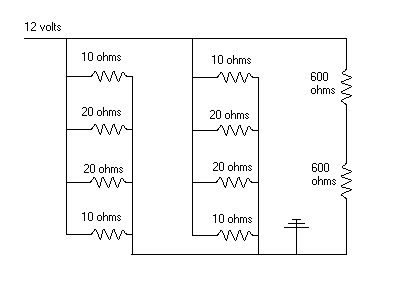 As we take a look at the COMPLETE diagragm it can been seen OVERALL as a Parallel circuit, but there are three branches in the circuit. The FIRST branch is a Parallel circuit. The SECOND branch is the same a Parallel circuit. The THIRD branch however is a Series circuit. So to work out the Amperage for the circuit, for the first two branches you use KIRCHOFF'S LAW. Then use OHMS LAW for the final branch. The First branch totals 3.6 Amps. the Second branch is the same 3.6 Amps. using KIRCHOFF'S LAW But the Third branch is a Series circuit so we add the Amps using OHM'S LAW Now you know the VALUE of each branch on the complete circuit. So as an overall Parallel circuit we add the Amps of each branch, for a total of 17.2 Amps. Again you can check it using KIRCHOFF'S LAW.
|