
 A Canadian Company
TR6 Frame Problems in conjuction with the video. |
 |
|
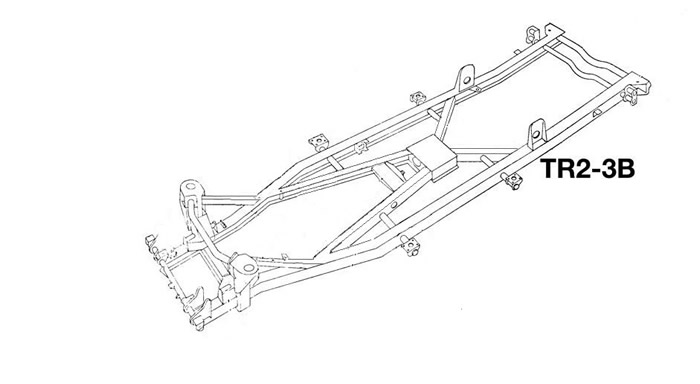
The original type of frame used in the TR2-3A was of the Ladder type. The Ladder Frame has two main chassis rails running the length of the car usually in parallel that carry all the running gear such as the axles front and rear including the spring assemblies on the underside of the rails. The engine and transmission are fitted between the rails with the steering assemblies hung on the rails with links to the king pin assemblies on the front axle. The body which is self contained is then simply bolted on top of the whole assembly. This type of frame is really as basic as it gets. It was used from horse and cart days. It is in all honesty the most simplest and cheapest way to construct a vehicle frame. The frame performed well when the needs and power of the car were limited. Problems began to show up when speeds and power output from the engines began to increase to say nothing about comfort and handling. With the early use of the Ladder Frame the axles were of course solid and the frame mounted using Half Elliptic springs This is still true on the rear of the TR2-3A and some of the TR4's. The TR2-6 of course uses Independent Front Suspension. This immediately moves the load from the frame at two points a side (referring to an older 1/2 Elliptic set-up) to the top of the tower holding the coil spring which creates a lot more stress on the front of the frame with the weight focused in one place and the tower serving as a lever. That results in a twisting motion in the front of the frame against the rear end of the frame. The cross piece welded into the frame in the centre was to try and counter this problem which it did to a certain extent. The thickness of the frame itself (that is the depth, not the metal thickness) also made a difference. |
| Continue Page 2 |