A Canadian Company
Kirchoff's Law |
|
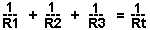
KIRCHOFF'S LAW is for calculating the values in a Parallel Circuit. There are fundamental differences in the Series and Parallel Cicuits. Therefore a different set of rules apply to the Parallel Circuit compared to the Series Circuit. The formula for KIRCHOFF'S LAW is as follows:- So to calculate the following 12 Volt Parallel circuit, the Resistor(A) has 200 (Ohms).) Resistor(B) has 300 (Ohms). and Resistor(C) has 600 (Ohms). |
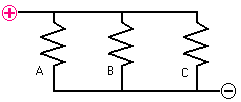 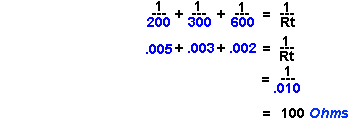 |
| Notice that with KIRCHOFF'S LAW the Resistance of each branch is calculated and a Total Resistance is reached. To find the amount the circuit uses in Amps you must use OHMS LAW divide the Volts by the Amps giving you the answer .12 Amps = (12 Miliamperes)
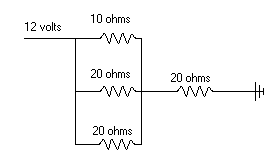
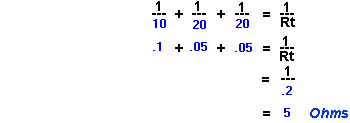
You can also use OHMS LAW to calculate the circuit values, but you must only calculate one branch of the circuit at a time, and there must be no resistance in series after the branch. Find the Amps each leg requires. You have Volts and Ohms of each branch. Once you have the Amps value of all the branches in the circuit, add them together. (Remember the rules) see what you get. Natually it should be .12 Amps Looking a the circuit below, It is an example where the Parallel Circuit needs to be calculated before the complete circuit which is a Series Circuit can be calculated. |
  |
|
In this case only KIRCHOFF'S LAW can be used to calculate the Series Circuit as the last resistor will affect the voltage of the Parallel Circuit Using OHMS LAW now we add the two Ohms values together as it is now a Series circuit we are working with, for a total of 25 Ohms and resulting in .48 Amps for the circuit. Using the Amps muliplying the Ohms we can see the Voltage drop across each section of the circuit. Using OHMS LAW now we add the two Ohms values together as it is now a Series circuit we are working with, for a total of 25 Ohms and resulting in .48 Amps for the circuit. Using the Amps muliplying the Ohms we can see the Voltage drop across each section of the circuit.
|